
Total Hip Replacement Surgery in Delhi
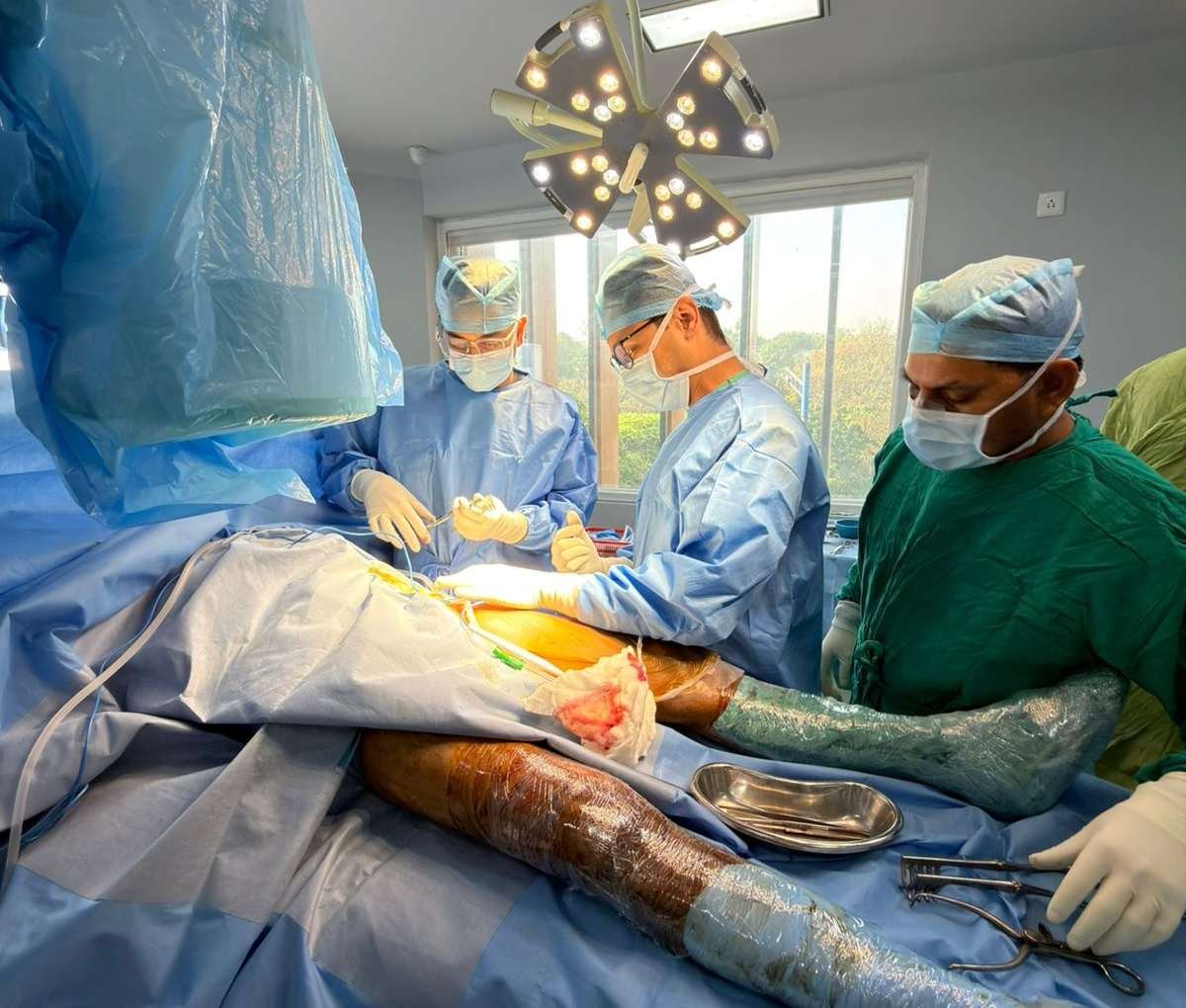
A worn-out hip is one of the most disabling things in orthopaedics — and hip replacement is one of the most reliably successful operations in all of surgery. Most patients are standing the day after, home within a week, and walking without a stick inside six.
At Sama Hospital — a NABH-accredited, doctor-owned hospital in South Delhi — hip replacement is performed by a team of nine orthopaedic consultants. The surgeon you meet is the surgeon who operates.
What Is a Total Hip Replacement?
The hip is a ball-and-socket joint. When the cartilage lining it wears away — through osteoarthritis, rheumatoid arthritis, or avascular necrosis, where the blood supply to the ball dies — bone grinds directly on bone. That is the pain.
A total hip replacement removes the damaged ball and socket and replaces them with a prosthesis: a smooth ball on a stem seated inside the thigh bone, articulating with a new socket fixed into the pelvis. It does not repair the joint. It replaces it.
Symptoms That Bring People In
- Deep pain in the groin — not usually the outer hip — on walking or standing
- Stiffness, and a hip that will not move as far as it used to
- Difficulty putting on socks and shoes, or getting in and out of a car
- A limp
- Night pain — often the symptom that finally decides it
When Is It Time?
When the pain limits your life and non-surgical treatment has stopped working. Not when an X-ray looks bad.
X-ray appearance and symptoms frequently do not match. We see terrible-looking hips in people who walk comfortably, and we see modest-looking ones in people who cannot sleep. We treat the patient, not the film. If you are sleeping through the night and walking without difficulty, you do not need a new hip yet, whatever the X-ray shows.
Equally, there is no prize for waiting too long. A hip left until the muscles have wasted and the other joints have compensated is a harder operation with a slower recovery.
Before We Operate
Weight management, physiotherapy to keep the muscles around the joint strong, walking aids, and appropriate pain relief all have a place, and for many patients they buy years. Avascular necrosis caught early can sometimes be treated with a joint-preserving procedure rather than a replacement.
We will tell you honestly which stage you are at.
Recovery
- Day 1 — you stand and take steps with a walker
- Days 3–5 — home
- Weeks 2–3 — walking with a stick
- Week 6 — most patients walking unaided
- Month 3 — physiotherapy complete for most; back to normal life
Physiotherapy is not optional. The operation gives you a new joint; the physiotherapy gives you back the muscles that work it.
Cost of Hip Replacement in Delhi
We quote an all-inclusive package, confirmed after clinical assessment. What moves the figure:
- The implant used — the single largest variable, and it should be chosen for your age and activity level, not your budget alone
- Whether one hip or both are replaced
- Primary or revision surgery
- Type of anaesthesia, room category and length of stay
- Physiotherapy included in the package
Cashless treatment is available for eligible insurance patients. See our cost estimate page.
Why Choose Sama Hospital
Sama is doctor-owned and NABH-accredited, treating South Delhi since 1982, with nine orthopaedic consultants — a genuine depth of team for a hospital of our size. Every one of them is named on this page with their qualifications.
A doctor-owned hospital has no revenue target pushing you toward the theatre. If your hip does not need replacing yet, we will tell you so.
Frequently Asked Questions
How long does a hip replacement last?
Modern implants commonly last 15 to 20 years or more, and a large proportion are still working at 20 years. Longevity depends on your age, weight, activity level and the implant chosen — a younger, heavier, more active patient will wear one faster.
When should I have it done?
When pain limits your life and non-surgical treatment has stopped working — not when an X-ray looks bad. X-ray changes and symptoms often do not match.
How soon will I walk?
Most patients stand and take steps with a walker the day after surgery. Home in three to five days, a stick at two to three weeks, unaided at around six weeks.
Can I sit cross-legged or squat afterwards?
This matters in Indian homes and deserves a straight answer. Traditional hip replacements carry restrictions on squatting and cross-legged sitting, especially in the first three months, because of dislocation risk. Many patients do return to floor sitting later, and both implant choice and surgical approach affect this. Raise it before surgery, not after — it can change what is implanted.
Is it painful?
There is real pain for the first few days, controlled with modern pain relief. But most patients find the arthritis pain they came in with is gone immediately. The pain afterwards is surgical — and it settles.