
Minimally Invasive & Endoscopic Spine Surgery
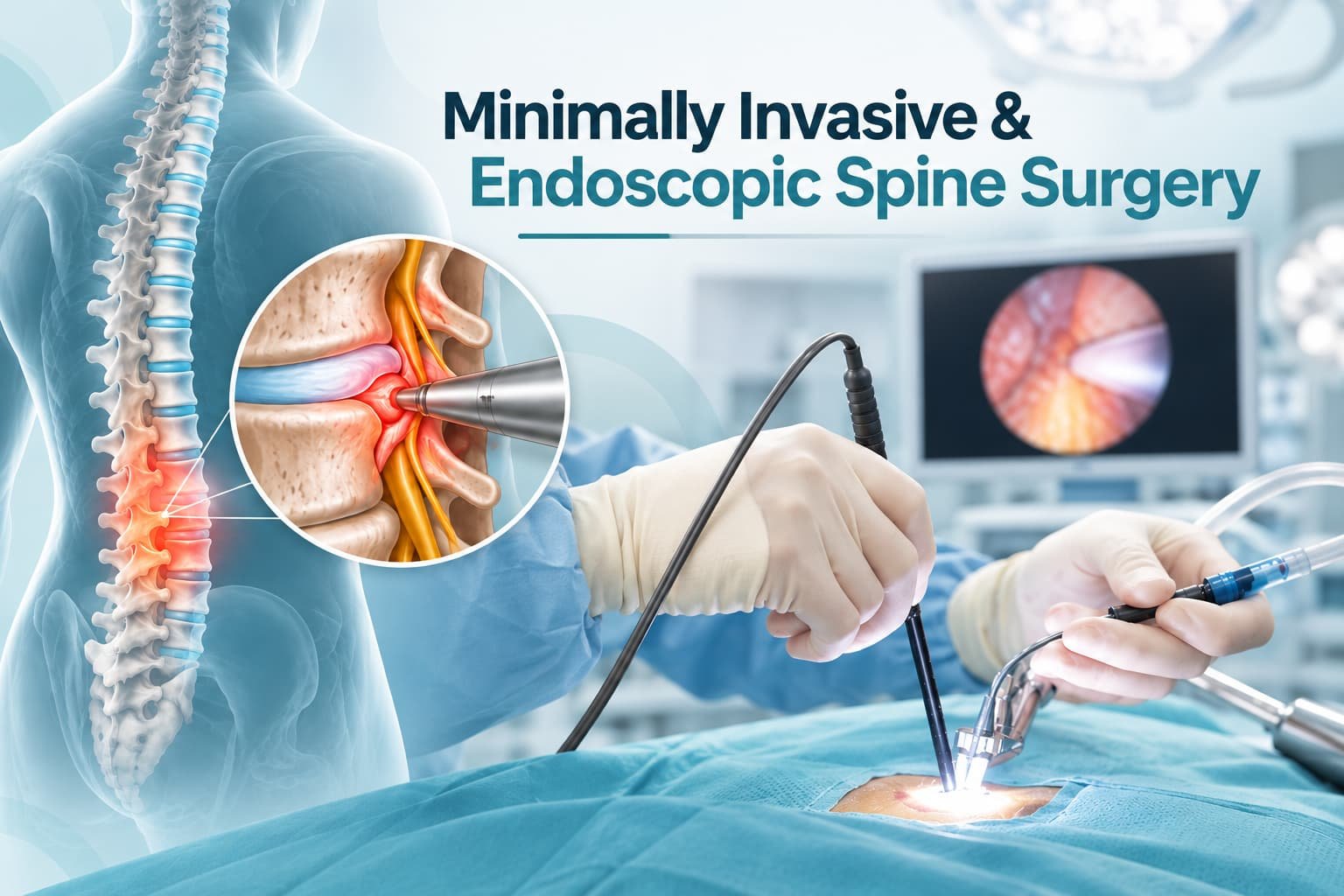
Most back pain never needs an operation. Most slipped discs get better on their own. Before anything else on this page, that is the thing worth knowing.
Sama Hospital’s minimally invasive spine service exists for the smaller group of patients where that isn’t happening — where leg pain, numbness or weakness has persisted despite medicines and physiotherapy, and where an MRI shows something that explains the symptoms. For those patients, endoscopic and minimally invasive techniques can relieve nerve pressure through an incision of under a centimetre, often as a day-care procedure.
Who leads the service
Dr. Om Prakash Gupta — Senior Consultant, Orthopaedic & Endoscopic Spine Surgeon
Dr. Om Prakash Gupta specialises in minimally invasive, microscopic and endoscopic spine surgery. He completed his MBBS at L.L.R.M. Medical College, Meerut (2004) and his MS (Orthopaedics) at King George’s Medical University, Lucknow (2008), followed by a Post-Doctoral Spine Fellowship at Ganga Hospital, Coimbatore (2013), an IASA Spine Fellowship at Mount Sinai Hospital, New York (2014), and a Fellowship in Endoscopic & Deformity Spine Surgery in Seoul, South Korea.
At Sama he performs endoscopic and minimally invasive spine procedures, and assesses patients with back pain, neck pain and sciatica — including the many for whom surgery is not the answer.
What “minimally invasive” actually means — and what it doesn’t
It means reaching the problem through a small working channel rather than opening and retracting muscle to see it directly. Less muscle disruption means less post-operative pain, less blood loss, and usually a faster return to ordinary activity.
It does not mean a different or better cure. We want to be straight with you about this, because a lot of what is written about keyhole spine surgery online is not.
What the evidence genuinely shows. In the largest randomised trial comparing endoscopic with open discectomy, patients having the endoscopic operation were far more likely to go home the same day (94% versus 6%), had a much smaller scar (about 12 mm versus 38 mm), and were less likely to still need strong painkillers two weeks later (13% versus 29%).
What it does not show. Pain relief and function a year or two later are much the same either way. The operation does not take less time — in that trial, operating times were identical. And in some comparisons, a wider decompression is achieved through the open approach.
So the honest summary is: the same result, with an easier recovery. Anyone telling you keyhole surgery gives a better long-term outcome, or that it is risk-free, or that it is guaranteed to work, is overselling it.
What matters more than the technique. The published evidence is clearer about this than about any instrument: outcomes track the experience and case volume of the surgeon. These techniques have a real learning curve, and complications cluster in a surgeon’s early cases. When you are choosing where to have spine surgery, ask how often the surgeon performs the specific operation you need. It is a fair question and a better one than asking which device is used.
Conditions we treat
- Lumbar disc herniation (slipped disc, PIVD) with sciatica — leg pain, numbness or weakness from a disc pressing on a nerve root
- Lumbar spinal stenosis — narrowing of the spinal canal causing leg pain and heaviness on walking that eases on sitting or bending forward
- Cervical disc herniation with arm pain, numbness or weakness
- Facet joint pain and mechanical low back pain that has not settled with conservative treatment
- Low-grade degenerative or isthmic spondylolisthesis — one vertebra slipped slightly on another
- Osteoporotic vertebral compression fractures — painful spinal fractures in weakened bone
- Suspected spinal infection or tuberculosis — including image-guided needle biopsy to confirm the diagnosis and guide treatment
Procedures
The main endoscopic operation for a slipped disc pressing on a nerve. A working-channel endoscope — a thin tube carrying a camera, light, irrigation and instruments — is passed to the disc through an incision of roughly 8–10 mm, either from the side through the natural opening where the nerve exits (transforaminal) or from behind between two vertebrae (interlaminar). The fragment pressing on the nerve is removed under direct vision.
A laser is sometimes used as one of the instruments inside the endoscope, to control bleeding or shrink tissue. It is worth being clear that the laser is not what treats the problem — removing the fragment is. Procedures marketed purely as “laser treatment for slipped disc,” with no fragment removal, rest on much weaker evidence, and we don’t present them as equivalent.
Most patients go home the same day or the next. Leg pain often improves immediately; numbness and weakness recover more slowly and sometimes incompletely, particularly if they have been present for a long time before surgery.
You may see this called PELD, TELD, PTED, TESSYS or “keyhole disc surgery.” These are largely different names — some of them brand names — for the same family of operations.
Where the spinal canal has narrowed and walking distance is limited, bone and thickened ligament are trimmed to make room for the nerves, through a small working channel. Where both sides need relief this can often be done from one side (unilateral laminotomy for bilateral decompression), sparing the structures that hold the spine stable.
An honest caveat: where stenosis is severe at several levels and symptoms affect both legs, the chance of needing a further procedure later is meaningfully higher than for single-level disease — in one study about one in ten within the follow-up period. We would discuss that with you before, not after.
Unilateral biportal endoscopic surgery (UBE)
A variation using two small portals instead of one — one for the endoscope, one for instruments — which gives more freedom to use conventional surgical tools. Used for decompression and discectomy.
Tubular and microscopic minimally invasive discectomy
A small tubular retractor and a microscope, rather than an endoscope. A well-established technique with a long track record. We should say plainly that trials have not shown it to be better than a conventional open microdiscectomy — the honest advantage is a smaller wound and less muscle disturbance, not a superior result.
Where a segment is unstable or a slip is causing nerve compression that decompression alone won’t fix, the segment can be fused through small incisions, with screws placed percutaneously under X-ray guidance.
Performed under X-ray guidance, never blind:
- Transforaminal epidural injection and selective nerve root block — targeted at a specific nerve root
- Epidural steroid injection
- Facet joint injection and medial branch block
- Radiofrequency ablation of the medial branch nerves for confirmed facet joint pain
These have two distinct jobs and it helps to separate them. As a diagnostic tool they can help confirm which structure is generating your pain, which changes what we do next. As a treatment, they can give useful short-term relief — but the average benefit over placebo in trials is modest, and injections do not reduce the likelihood of eventually needing surgery. We use them deliberately, not as a default, and we won’t tell you an injection will fix a structural problem.
For a painful recent spinal fracture in osteoporotic bone, cement can be injected into the collapsed vertebra through a needle.
This needs honest framing. Several sham-controlled trials found no benefit over a placebo procedure, and expert guidance genuinely disagrees about it. Where it appears to help is a specific group: a recent fracture, confirmed as recent on MRI, with severe pain that matches the level, and pain that isn’t controlled by ordinary means. We would only offer it with that confirmation, and never without also treating the underlying osteoporosis — which is what actually prevents the next fracture.
Percutaneous spinal biopsy
A needle biopsy taken under X-ray guidance where infection or tuberculosis of the spine is suspected. Getting a tissue diagnosis before starting long courses of treatment matters, particularly in India where spinal TB is common and can look like other things on imaging.
Most slipped discs get better without surgery
Pooled research covering more than 2,000 patients found that about 63% of lumbar disc herniations shrink on their own with non-surgical treatment. More surprisingly, the larger ones regress most often — around 96% of the most extruded fragments, compared with 13% of mild bulges.
Which means a frightening MRI report is not, by itself, a reason for an operation. What matters is your symptoms, how they are changing, and whether you have any neurological deficit.
Surgery reliably does one thing well: it relieves nerve-compression pain faster than waiting. Over several years, the gap between operated and non-operated patients narrows. So the real question at your first appointment is usually not “keyhole or open?” but “does this need an operation at all, and if so, when?”
One exception matters and is genuinely urgent. Loss of bladder or bowel control, numbness around the saddle area, or rapidly worsening weakness in both legs needs assessment the same day, not an appointment. Go to an emergency department.
What to bring to your appointment
- Any MRI or CT of your spine — the films or the disc, not just the report
- X-rays, if you have them
- A list of the medicines you are taking
- A rough timeline: when it started, what has changed, what you have already tried, and what makes it better or worse
- If you have had a nerve conduction study or a previous spinal operation, bring those records
Frequently asked questions
Is endoscopic spine surgery better than open surgery?
For recovery, yes — meaningfully. In the largest randomised comparison, 94% of endoscopic patients went home the same day versus 6% after open surgery, the scar was about a third of the size, and fewer patients still needed strong painkillers two weeks later. For the long-term result, no: pain and function a year or two afterwards are much the same. The operation itself is not quicker. The most reliable predictor of a good outcome is not the technique but the surgeon’s experience with that specific operation.
Will my slipped disc heal without surgery?
Very often, yes. Pooled research on over 2,000 patients found about 63% of lumbar disc herniations shrink on their own without surgery, and larger fragments regress more often than small bulges. Most patients with sciatica improve with time, medication and physiotherapy. Surgery is considered when symptoms persist despite that, or when there is progressive weakness. Loss of bladder or bowel control is an emergency and needs immediate assessment.
What are the risks of endoscopic spine surgery?
It is surgery, and it carries real risks: a tear in the covering of the nerves (around 1 in 100), infection of the disc (under 1 in 100), nerve injury, and bleeding. Temporary tingling or altered sensation in the leg is the most common complaint afterwards and usually settles. Around 6% of patients have a recurrence within two years, and 5–6% need a further operation within a year. Endoscopic surgery also has one or two risks open surgery does not, related to the fluid irrigation used. We will go through the ones that apply to you before you consent.
How soon can I go back to work after keyhole disc surgery?
Most patients go home the same day or the next, and walk the same day. Desk-based work is commonly resumed within one to two weeks, though this varies. Heavy lifting, driving for long periods and manual work take longer and depend on the specific operation. There is no good trial data on return to work after endoscopic discectomy, so any precise figure you see quoted is an estimate from experience rather than a measured one.
What happens at my first appointment?
We take a history, examine you, and review your imaging — which is why bringing the actual MRI films or disc matters more than the report. Many patients leave with a non-surgical plan: medication, physiotherapy, activity modification, and a review date. If an injection would help clarify which structure is causing your pain, we will explain what it can and cannot tell us. If surgery is worth considering, we will set out what it involves, what it is likely to achieve, what it will not fix, and the alternatives — including waiting.
Making an appointment
Sama Hospital, 8 Siri Fort Road, Sadiq Nagar, New Delhi 110049. 24/7 emergency; specialist OPD during daytime hours.
For an estimate of cost, call us. We don’t publish procedure prices, because the honest answer depends on what you need — and anyone quoting you a fixed price for spine surgery before seeing your MRI is guessing.