
MBBS, MS

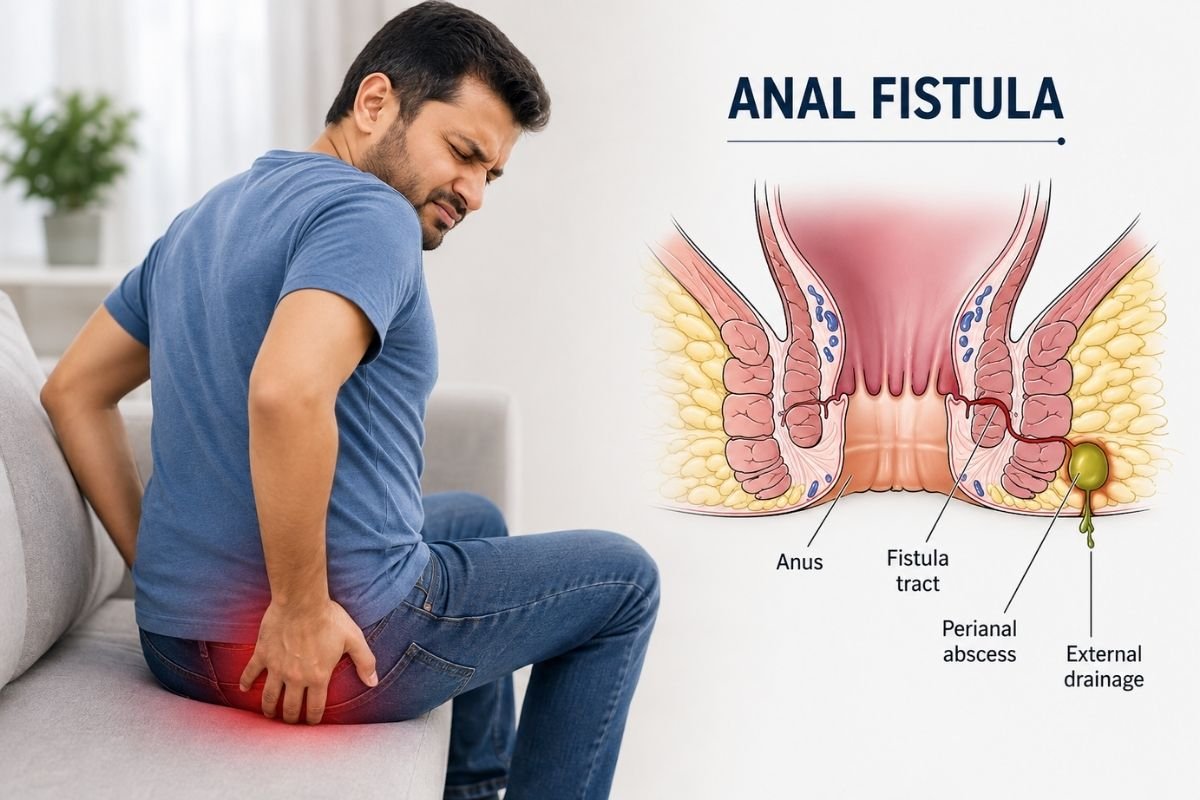
An anal fistula is a small abnormal tunnel connecting the inside of the anal canal to the skin near the anus, usually forming after a previous anal abscess. It rarely heals on its own and almost always needs surgery. At Sama Hospital — a NABH-accredited, doctor-owned hospital in South Delhi — most fistulas are treated with FiLaC (Fistula-tract Laser Closure), a minimally invasive, sphincter-preserving technique performed as day-care surgery.
A fistula-in-ano is a tract linking the anal canal to the skin beside the anus, most often following an anal abscess. Because the tract usually passes near — or through — the sphincter muscles that control continence, treatment has to balance two things: clearing the fistula completely, and protecting those muscles.
That balance is the whole of fistula surgery. Everything else is detail.
A fistula is not an infection that antibiotics can clear. It is an established tunnel lined with tissue. Antibiotics may settle a flare temporarily, but the tract remains and the discharge returns. Delaying treatment tends to make the tract more complex, not less — and complex tracts are harder to cure and carry more risk to the sphincter.
Fistulas are classified by the path they take relative to the sphincter muscle — intersphincteric, transsphincteric, suprasphincteric and extrasphincteric. In practice, what matters to you is whether your fistula is simple (low, single tract) or complex (high, branching, recurrent, or involving a large amount of muscle). That distinction drives both the choice of technique and the honest odds of cure.
FiLaC — Fistula-tract Laser Closure. A fine laser fibre is passed along the tract and withdrawn slowly, sealing it from within. The sphincter is not cut. Usually day-care, with a quick return to routine. This is our default for most tracts.
Fistulotomy. Laying the tract open. It has the highest cure rate of any technique — but it involves dividing tissue, so it is only appropriate for simple, low fistulas where the sphincter is not at risk.
Seton placement. A thread passed through the tract to drain it and allow inflammation to settle, sometimes as a first stage before definitive surgery on a complex fistula.
LIFT. Ligation of the intersphincteric tract — another sphincter-preserving option for selected transsphincteric fistulas.
You should know this before you choose. Sphincter-preserving techniques such as FiLaC protect continence, but have a somewhat higher recurrence rate than fistulotomy. Fistulotomy cures more reliably, but cuts muscle — and in the wrong fistula, that risks incontinence, which is far worse to live with than a recurrence.
Any surgeon who offers you one technique for every fistula is not weighing this trade-off. We will tell you which applies to your tract, and why.
Most patients go home the same day and return to desk work within a few days. The tract itself takes several weeks to heal fully, and some discharge during that period is expected. Sitz baths and dressing changes are usually all that is required at home.
We quote an all-inclusive package, confirmed after clinical assessment. What moves the figure:
Cashless treatment is available for eligible insurance patients. For an estimate for your case, see our cost estimate page.
Sama is doctor-owned and NABH-accredited, treating patients in South Delhi since 1982. Our surgeons are named on this page, and the surgeon you meet at consultation is the surgeon who operates.
Fistula surgery is a field where the wrong choice of technique has permanent consequences. A doctor-owned hospital has no incentive to push you toward the quickest or most profitable option.
This is the central question in fistula surgery. The tract often runs through or close to the sphincter muscles. Sphincter-preserving techniques such as FiLaC seal the tract without cutting muscle, which minimises the risk. Where the tract is simple and low, fistulotomy may still be the most reliable cure. Your surgeon should explain which applies to you, and why.
Rarely. A fistula is an established tunnel lined with tissue. Antibiotics may settle an infection temporarily, but the tract remains and symptoms typically return.
Fistula-tract Laser Closure. A fine laser fibre is passed along the tract and withdrawn slowly, sealing it from the inside. The sphincter muscle is not cut, so the risk to continence is low, and it is usually done as day-care surgery.
Yes. Recurrence is a genuine possibility with every technique, and is more likely with complex or branching tracts. This is the trade-off that sphincter-preserving surgery accepts in exchange for protecting continence.
For complex, recurrent or high tracts, an MRI fistulogram maps the tract in relation to the sphincter and is often essential to planning safe surgery. Simple, low fistulas can frequently be assessed clinically.
MBBS, MS


M.B.B.S, M.S

MBBS, MS