
MBBS, MS

A hernia is a gap in the abdominal wall through which tissue pushes out, producing a bulge. It cannot heal by itself, and surgery is the only cure. At Sama Hospital — a NABH-accredited, doctor-owned hospital in South Delhi — most hernias are repaired by laparoscopic (keyhole) surgery: three small incisions, a mesh placed behind the defect, and most patients home the same day and back at a desk within a week.
The abdominal wall is a sheet of muscle. Where it is weak — at the groin, the navel, or the site of an old surgical scar — pressure from inside can push fat or bowel through the gap. The result is a lump that appears when you strain, cough or stand, and often disappears when you lie down.
The gap does not close on its own. It tends, slowly, to get bigger.
This is the part that matters, and it is why we do not recommend simply living with a hernia indefinitely.
If the contents of the hernia get trapped and their blood supply is cut off — strangulation — the tissue starts to die. It is a surgical emergency, and the operation then is bigger, riskier and may involve removing bowel.
Go to an emergency department immediately if a hernia suddenly becomes hard, very painful, cannot be pushed back in, or you start vomiting. A planned repair is a small operation. An emergency one is not.
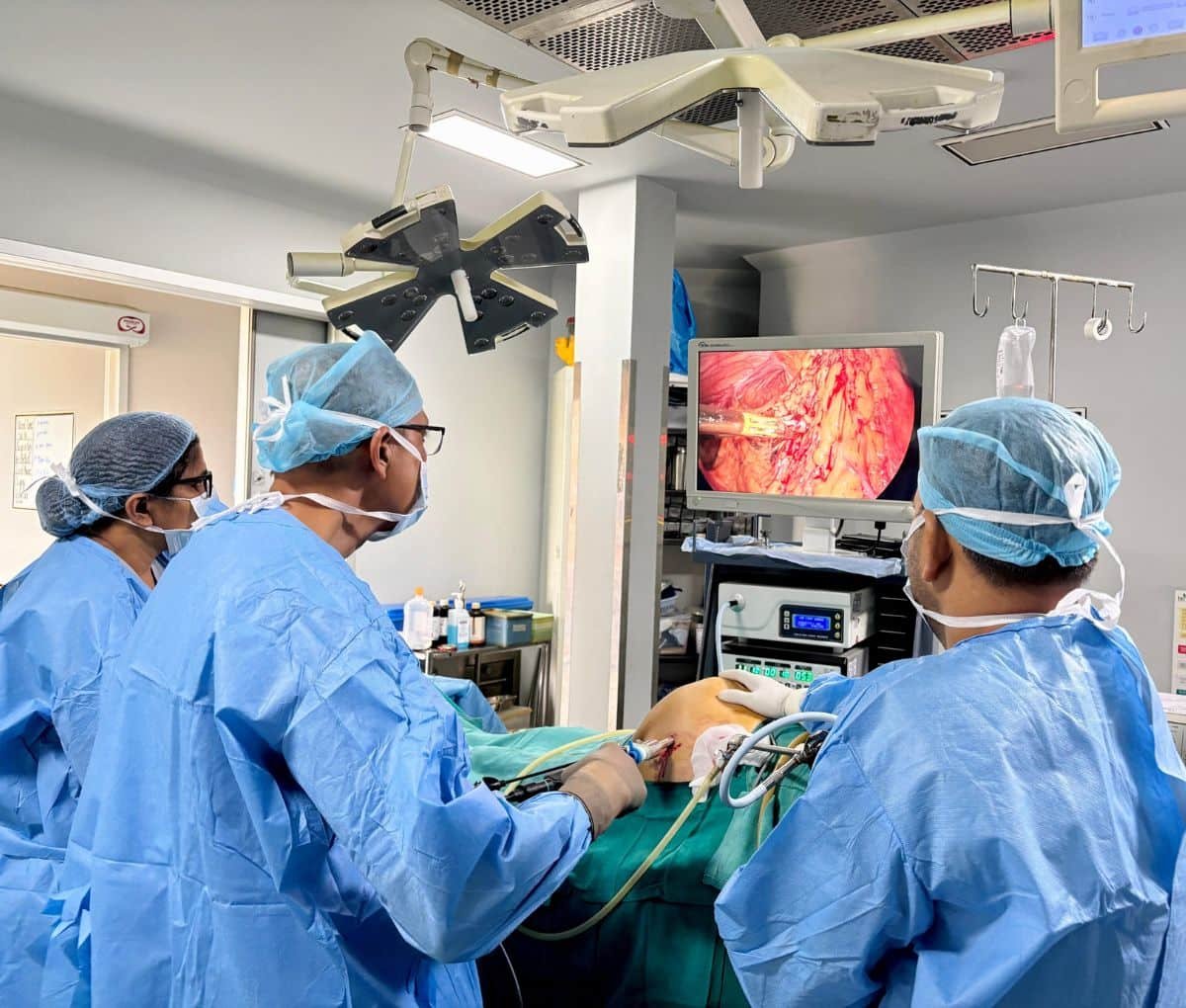
Keyhole surgery through three small incisions. A camera and fine instruments are used to place a mesh behind the defect, reinforcing the abdominal wall from the inside, where the pressure comes from.
Compared with open repair, this usually means less post-operative pain, a lower risk of wound infection, smaller scars, and a faster return to work — and it is particularly advantageous for hernias on both sides, and for recurrent hernias.
Open repair still has its place. Very large hernias, heavily scarred abdomens, or patients for whom general anaesthesia is too risky may be better served by an open operation. Both are sound; the right one depends on you, not on fashion.
Most patients go home the same day or the next morning. Desk work in about a week. Lifting, gym and strenuous work at four to six weeks — the mesh needs that time to integrate, and rushing it is how repairs fail.
We quote an all-inclusive package, confirmed after clinical assessment. What moves the figure:
Cashless treatment is available for eligible insurance patients. See our cost estimate page.
Sama is doctor-owned and NABH-accredited, treating patients in South Delhi since 1982. Our surgeons are named on this page, and the surgeon you meet at consultation is the surgeon who operates.
Hernia repair is one of the commonest operations in surgery, which is precisely why it is worth having done properly — by a surgeon who does a lot of them, in an accredited theatre.
No. A hernia is a physical defect in the abdominal wall and cannot close on its own. Belts and trusses may relieve symptoms but do not repair anything. Surgery is the only cure. A small, painless hernia in an elderly or high-risk patient may reasonably be watched — but it will not go away.
For most patients: smaller incisions, less pain, lower wound-infection risk, faster return to work. Open repair remains better for very large or heavily scarred hernias, or where general anaesthesia is too risky. Both use mesh and both are sound operations.
When the trapped contents lose their blood supply and begin to die. A surgical emergency. If a hernia suddenly becomes hard, painful and irreducible, often with vomiting, go to an emergency department immediately.
Desk work in about a week after laparoscopic repair. Heavy lifting and gym at four to six weeks.
Mesh has been used for decades and dramatically reduces recurrence compared with stitching the gap alone. Complications are uncommon, though a small minority of patients experience chronic discomfort at the site — which should be discussed before surgery, not after.
MBBS, MS


M.B.B.S, M.S

MBBS, MS