
MBBS, MS

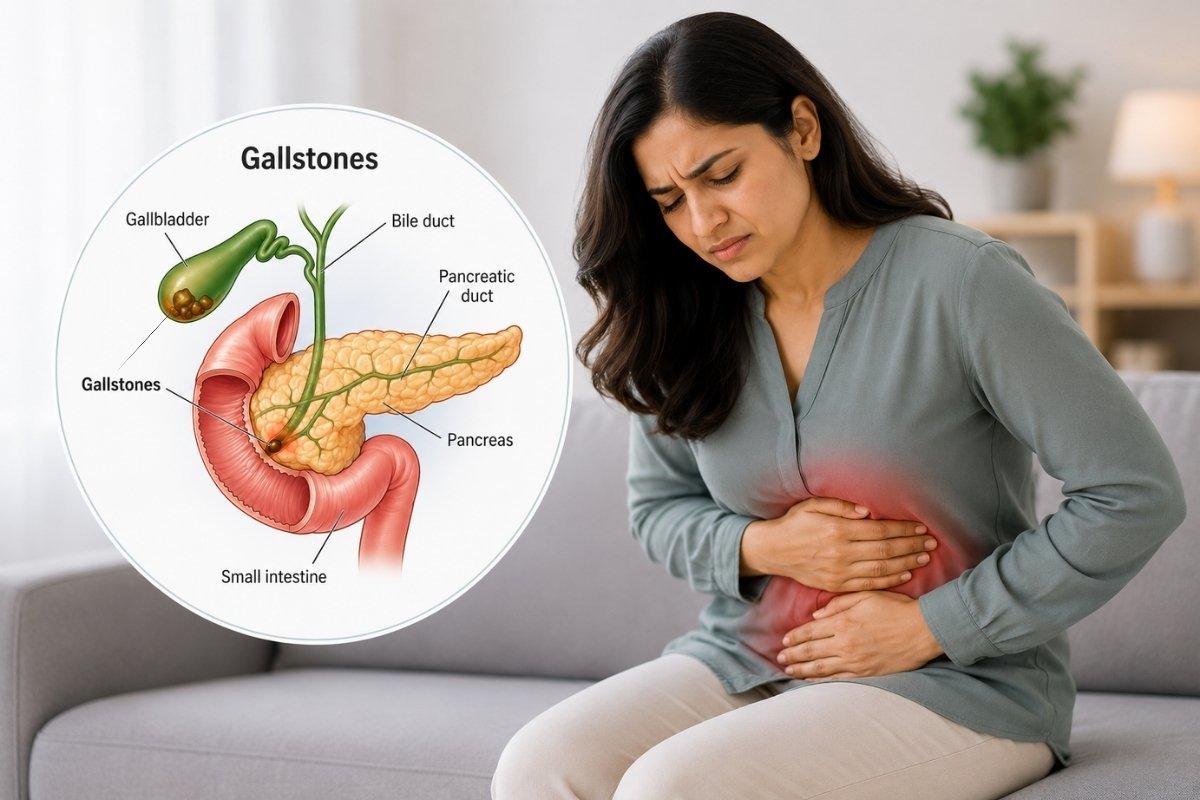
Gallstones are one of the commonest reasons for abdominal surgery, and one of the most rewarding to treat — once the gallbladder is out, the problem is over for good. At Sama Hospital — a NABH-accredited, doctor-owned hospital in South Delhi — gallbladder removal is done by laparoscopic (keyhole) surgery: three or four small incisions, most patients home within a day, and back to normal life inside a week.
The gallbladder is a small pouch under the liver that stores bile. When the chemistry of bile shifts, it forms stones — sometimes one large stone, sometimes dozens of small ones. Trouble starts when a stone blocks the outlet, and the gallbladder squeezes against the obstruction.
That is biliary colic: an intense, gripping pain in the upper right abdomen, classically an hour or two after a fatty meal.
No — and this matters. Gallstones picked up by chance on a scan, causing no symptoms whatever, can usually be left alone and watched. Most of them never cause trouble.
Surgery is for gallstones that are causing symptoms, or that have already caused a complication. Once stones have caused one attack, further attacks are likely, and each one carries the risk of something worse: an infected gallbladder, a stone lodged in the bile duct with jaundice, or gallstone pancreatitis.
We will tell you honestly which category you are in.
The operation removes the gallbladder itself, with the stones inside it — not just the stones. Taking out the stones and leaving the gallbladder simply lets them re-form.
Keyhole surgery, under general anaesthesia, through three or four small incisions. A camera and fine instruments are used to separate the gallbladder from the liver and bile duct and lift it out. It is among the most commonly performed laparoscopic operations in the world, and in experienced hands it is a safe, quick and well-tolerated procedure.
Occasionally — where inflammation is severe or the anatomy is unclear — a surgeon will convert to an open operation. That is not a failure. It is the correct decision, taken to protect the bile duct.
The gallbladder stores bile; it does not make it. After removal, the liver goes on producing bile exactly as before, and it flows straight into the intestine.
Most people eat entirely normally within a few weeks. Some notice looser stools after very fatty meals in the first months; this usually settles. There is no lifelong medication and, for the great majority, no permanent dietary restriction.
Home the same day or the next morning. Desk work in about a week. Heavy lifting at three to four weeks.
We quote an all-inclusive package, confirmed after clinical assessment. What moves the figure:
Cashless treatment is available for eligible insurance patients. See our cost estimate page.
Sama is doctor-owned and NABH-accredited, treating patients in South Delhi since 1982. Our surgeons are named on this page, and the surgeon you meet at consultation is the surgeon who operates.
If your gallstones are silent, we will tell you so and leave them alone. A doctor-owned hospital has no revenue target pushing it toward the theatre.
No. Stones found by chance and causing no symptoms can usually be watched. Surgery is for stones that are causing symptoms, or that have already caused a complication such as infection, jaundice or pancreatitis. Once stones have caused one attack, further attacks are likely.
Dissolution medicines work only for small, pure-cholesterol stones, take many months, and the stones commonly return once treatment stops. For most patients with symptomatic gallstones they are not a realistic alternative to surgery.
Yes. The gallbladder stores bile; the liver makes it. After removal, bile flows straight into the intestine. Most people eat normally within weeks. Some notice loose stools after very fatty meals early on, which usually settles.
Home the same day or the next morning; desk work in about a week; heavy lifting at three to four weeks.
Symptomatic stones can go on to cause an infected gallbladder, a blocked bile duct with jaundice, or gallstone pancreatitis, which is serious. Emergency surgery in an inflamed abdomen is a bigger operation than a planned one — which is why removal is usually advised once stones start causing symptoms.
MBBS, MS


M.B.B.S, M.S

MBBS, MS